Thursday, January 7, 2021
My Experience at the US Capitol Jan 6, 2021
Monday, December 7, 2020
What is "the best" scope for a scout rifle?
I hear this question all the time, particularly on Facebook. The question is usually about a specific brand or magnification, but the question really should be about the type of scope.
Before I start, let me provide a brief background so you know that this is coming form a person who has some experience with this. I've hunted with practical and scout style rifles for 30 years. I've taken probably close to 100 deer in the Virginia Piedmont which is mixed farm and woodland. I've taken 4 practical/scout rifle classes. I have a steel target "woods walk" range on my property. I've owned fixed power from Leupold and Burris. I've owned the variable scout scopes from both manufacturers. I've owned several low power conventional variables from Leupold. I've experimented and studied the problems. I've made it my goal to find the best general purpose optic for my purposes.
There are three basic types of scope a person can get on a scout rifle. A conventional scope, a scout scope or an intermediate scope. It is the intermediate scope that causes some issues because manufacturers call them scout scopes but they really are not. Scout rifle purists don't like them because they are not true scout scopes and I'll get into the details of that momentarily.
Scout Scopes:
A true scout scope will have an eye relief of 9 to 12 inches. At one time, Jeff Cooper actually said it could be as short as 6" but that is generally ignored because an eye relief that short contradicts some other scout rifle features.
Advantages:
- Allows the rifle to be carried in the field with the hand wrapped around the action which is very handy.
- Allows the use of stripper clips.
- Leaves the top of the action open for easier loading from the top
- Places the ocular bell far from the eye so the shooter doesn't get hit with it during recoil.
- Speed. It is incredibly fast to get onto target. This is not to be understated. If the magnification is below 3 power, your eye does something very cool. If you throw the rifle to your shoulder and keep both eyes open, you'll see your target with both eyes with your distance vision. The image in your dominant eye will have a magnified image with the reticle imprinted on it. It is a cool trick and makes the snap shot stunningly fast.
It is this last advantage that makes a true scout scope so desirable. It is why Cooper latched onto it. It works better with the scope mounted low to the bore. The magnified image in your dominant eye takes up only a small portion of your total field of view. It gives the shooter great situational awareness. On a range or in a training class, it excels beyond anything else.
This isn't a free lunch though. With the ocular lens so far from your eye, bad things happen in low light. Those same things happen if the target is obscured by brush or camouflage. Because that lens takes up such a small portion of your overall field of view, it means that there is a very small screen in which to find discreet target indicators. Targets that are easy to see in a conventional scope such as deer standing in a wood line at dusk at 100 yards fade into invisibility.
This caused me a lot of problems a few years ago. I had been aware of the problem at dusk, but it had not cost me the opportunity at a deer until one particular day. It wasn't even at dusk. It was in broad daylight. I came over a rise and used my binoculars to scan a brushy draw about 150 yards down a hill. I saw a herd of deer filtering through the brush. I got into a steady position and put up my rifle. I couldn't find them. It was like they vanished. I checked again with the binos and they were still there and were easily visible. Again to the scout scope and I could not for the life of me find a target indicator that would allow for an ethical shot. It was extremely frustrating and started my quest for a better solution.
Several years later, after switching to a low power conventional scope for a while, I tried the Burris 2-7 Scout. I figured my problem had been one of magnification so being able to crank up the power would fix things. It helped a little, but didn't cure things. The ocular lens is still too far from my eye to allow for really good target discernment. It isn't a particularly good lens in the first place and was not as bright as other scopes and had a distinct fish-eye effect at the edges and I gave up on that as well.
Conventional Low Power Variable Optic (LPVO):
After giving up on the scout scope back in 2006 (might have been 2007), I decided to try a LPVO. I found the best one I could get at the time which was a Leupold Mark 4 1.5-5X MR-T with an illuminated reticle. I like this scope a lot. It is not as fast at a scout scope for snap shots. A scope that is 4" from your eye doesn't allow for the wide open field of view of a scout scope and one can quickly get "lost in the scope" even at low magnification. It isn't horrible either. At 1.5 power, it is pretty quick. The big advantage though is low light performance. I could hunt right to the end of legal shooting light with no problems. Longer targets in the woods were no issue. Essentially, anything inside 300 yards was easy and that wasn't just targets on a range. If I could find it in my binoculars, I could find it in the scope and that made it a superior scope for a general purpose rifle.
A LPVO is a really solid choice for a GP rifle. It has a couple of downsides. Having an ocular lens 4" from your eye means hat brims often get in the way. That may not sound like a big deal and on a range, it isn't. In the hunting field where you may need to get off a shot quickly, it can be. Anything that distracts from the act of shooting at the critical moment is a problem. As I mentioned, it is also slower because when you raise the gun to your face, you must cover your target with the scope and then find it again in the scope. Scout scopes don't have this issue since you keep your focus on the target while the gun comes up and then just allow the dominant eye to pick up the magnified image.
The advancement of the AR platform in the last few years has created a huge market for good quality LPVOs. Some people want a true 1X magnification at the low end and while I don't see the need for that, they exist. There are plenty of scopes with illuminated reticles with a high end magnification of 6 to 8 power and any one of them would be appropriate on a general purpose rifle.
The Compromise:
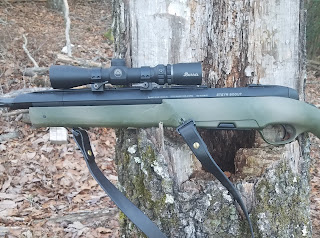
An intermediate eye relief scope will have between 6 to 7 inches of eye relief and some still call this a "scout scope" but it really isn't. Leupold has made two of these and they discontinued one of them. I've written about this so much at www.scoutrifle.org that one person actually made a chart and labeled the intermediate position as the "Cliffy Position" after my username there. I have apparently been fairly convincing that this is far and away the best way to set up a general purpose rifle. It gives the shooter the best of both worlds with very little given up to either the scout or conventional scopes.
What I have learned is that the Leupold VX-R Scout 1.5-5X scope is that it works just as well as some higher end LPVOs in low light and is nearly as fast as a scout at the snap shot.
The odd thing about the VX-R is that it doesn't allow the scope to be mounted in either the scout nor the conventional rings of a Steyr Scout. The rear ring needs to use the front conventional slot and the front ring uses one of the rear scout scope slots on the top of the receiver. That places the ocular lens 6" from my eye and that opened up a whole new reality.
Speed:
The VX-R does occlude more of my vision than a scout scope, but it has another trick up its sleeve. It has an illuminated red dot reticle. That allows for something different. The correct way to use a rifle reticle is to focus on the target until it is time to verify sight alignment. At that point, one changes focus to the reticle itself. It is a brief thing and is the equivalent to the pistol shooter focusing on the front sight. With a red dot, this is not required. That glowing dot just imposes itself on the target in the vision of your dominant eye and you really don't have to shift focus. It makes up for the slight loss of speed because of this. It is truly remarkable.
Low light, hidden and camouflaged targets:
The ocular lens of the VX-R is not only closer to my eye, but the lens itself is 50% larger in surface area than the scout scope. When the gun comes to my shoulder, that means the lens occludes much more of my vision and makes it very easy to find minute target indicators. Like a LPVO, if I can see it in my binos, I can see it in the scope.
What really amazed me was the low light performance. Some of this is the quality of the lens but I'm certain that the large lens and its proximity to my eye helps a lot. Last hunting season, I noticed that I could see deer even past legal shooting light. I wasn't sure if I was imaging this or if it really was that good. Then I was able to prove that is was that good.
I took a Randy Cain Practical Rifle class which included a night shoot. At dusk, he had all the shooters get into the prone position and wait for a called shot. They were to stand up when they could not see the target clearly enough to take a killing shot. The targets were camouflaged and were in color coded stands. The class had 14 shooters with a mix of optics. There were a few moon scopes, several LPVOs, a few scouts and my VX-R. Over the next 20 minutes, we stayed on the line. I didn't realize when other shooters stood up. At one point, the colors were starting to fade and I had to bear down to ensure I had an ethical shot. I did. Randy called for one more shot and only two of us fired. After that shot, both of us put up our hands and stood up.
I look at at my watch and did a quick calculation. It was 40 minutes after sunset. I had been able to see the target clearly enough in my scope to see the kill zone and to see the color of my target stand a full 10 minutes past legal hunting hours. The other scope that did this? A Leupold Mark 6 1-6X scope which is a $1600 optic. The VX-R proved that it gives up nothing to a LPVO in low light.
Other advantages:
The VX-R doesn't allow one to carry the rifle by wrapping the hand around the action, but it does put the ocular lens far away enough from the face that the brim of a hat doesn't get in the way. There is no chance of getting hit by the ocular bell during recoil. Being mounted on a Steyr means access to the top of the receiver is moot.
The other Leupold:
The VX Freedom 1.5-4X and the earlier VX-II 1.5-4X scout scopes are also listed at 6 to 7 inches of eye relief. They are good scopes and are very light weight. They are smaller than the VX-R and not as bright in low light. They are brighter than the Burris 2-7 Scout and I have not compared it to a fixed power scout scope. Both the VX Freedom and VX-II scout have very long ocular bell housings and that does complicate mounting. They cannot be mounted in the same way as the VX-R and it will end up closer to 7" by the time you're done. They are still handy and good in low light and I consider them to be the best intermediate option now that Leupold discontinued the VX-R.
So what is the best scope to put on a scout rifle? If you can find a VX-R, that is clearly the best bet but finding one is no easy task. Unless Leupold decides to make them again, the options are slim. Other than that, one needs to ask themselves some serious questions. Is this gun for range use or hunting? Is the hunting in low light? How much is speed an issue? Weight is a consideration as well and most LPVOs tend to be on the heavy side (notable exception is the Leupold VX-IIIi 1.5-5X which is less than 10 ounces). If I didn't already own the VX-R and I was setting up a scout rifle for true general purpose use, I'd chose a LPVO but would always keep my eye open for new offerings in the market. If somebody made a scout scope with the same advantages as the VX-R, I'd certainly give it a try.
Wednesday, September 2, 2020
Jeff Cooper General Rifle Class by Tom Russell
I'm always at a loss as to how to start these reviews. The bottom line is, it was a fantastic class, but there's a lot to unpack in describing it.
Friday, July 24, 2020
The 3 Kilogram Scout Rifle
Wednesday, December 4, 2019
The unasked impeachment question
What bothers me is that nobody seems to be asking the most pertinent question. Not even conservative talk radio really delves into this very much. Yes, that scares me and makes me question if I'm thinking straight on this matter, but it seems too friggin' simple to me.
That question is: Is there any national interest in having Ukraine investigate Burisma and Crowdstrike?
Why is that question important? Because every time we give foreign aid to another country, there needs to be something in it for this country. That is not in dispute. What is in dispute, is the idea that President Trump asked for something that only benefits him. The Democrats want us to believe that there is no other motivation for asking for those investigations other than to benefit Trump at the ballot box in 2020.
Is that true? I don't know. Nobody is asking the question. Trump specifically mentioned Burisma and Crowdstrike in his phone call to the Ukrainian president. Why wouldn't the Republicans insist on this being examined? Why wouldn't Trump make this a central part of his defense? It seems glaringly obvious to me, but I only hear it mentioned in ancillary discussions of impeachment.
A quick Google search shows that Burisma's founder was under investigation for massive embezzlement of government funds and money laundering. This dates to the time before they hired Hunter Biden but the investigation happened during his tenure on their board and Joe Biden also forced Ukraine to fire the prosecutor who was looking into the matter. Money laundering and embezzlement of government funds is something our government should be concerned about when we're about to give them large sums of our tax dollars. Related to that, I think it is important to know why Joe Biden held up $1 billion in aid until that prosecutor was fired. What was that guy accused of? What did Joe Biden know about him to want him fired so badly?
Crowdstrike... the DNC and its media acolytes keep claiming this is a "debunked" conspiracy theory. I'm not sure they understand the meaning of the word "debunked." What they have done is to present their version of what they claim is being said about Crowdstrike and then debunking that story. It is a classic strawman fallacy. Nobody has explained why the DNC would not turn its hacked server over to the FBI but instead sent it to Crowstrike The FBI has never examined the server to see who actually hacked it.
Debunked? Has this Politico article been debunked? https://www.politico.com/story/2017/01/ukraine-sabotage-trump-backfire-233446 For those unfamiliar, Politico is a hard left publication that is no friend of the President. If this article is even only partially true, Trump has good reason to be very leery of Ukraine and how they approach the American election system. They clearly manipulated information to benefit Clinton in 2016 and that lead to the Mueller investigation.
I say, let's have an honest impeachment inquiry. Let's see if President Trump's actions only benefit himself or if there is a greater national interest involved. Did any members of the Ukrainian oligarchy also get involved with the 2016 election? Are there things happening in Ukraine now that are carried over from previous governments that will affect our relationship and how our tax money is spent? Is it a country that we can trust with millions of dollars?
On a related but separate note, I am still baffled that people don't get what "draining the swamp" meant. The swamp dwellers think they run foreign policy. They don't... or shouldn't. They are unelected and their only function is to implement the foreign policy of the chief executive. The "inter-agency consensus" is irrelevant. If the President has to resort to "back channels" to get his policy implemented, then that is just more evidence of a deep state coup.
Everything a President does should benefit his reelection efforts. The better the country does, the better an incumbent does. The question is whether his efforts were for purely personal gain or if there were any national interests as well. Answer that question and impeachment becomes crystal clear. Unfortunately, nobody is asking that question.
Monday, September 9, 2019
The Clifford GP Rifle
That doesn't mean we can't find ways to make it better. We can look at Cooper's experiences and compare them to our own and figure out what works best for us. Just be aware that what comes out of that may or may not be a "scout rifle" under the terms of the scout rifle canon.
I've been a devotee of Cooper's since 1990. Everything I've done with rifles has had some Cooper influence. I've finally come up with what I consider to be the ultimate general purpose rifle. The thing is, I'm not sure I can consider it a "scout rifle" but I really don't care. The fact is, the rifle is considerably more versatile than a textbook defined Scout.The rifle started off life at a Steyr Scout rifle. I used it for years and it served me well, but had a couple of shortcomings.
First, let's address the scope. I've tried just about every scope under the sun for a scout rifle. I've had the Burris and Leupold fixed power scout scopes. I've tried the variable power scout scopes from both companies as well (2-7X for Burris and 1.5-4X for Leupold). Until now, the best I had used was the Leupold Mark 4 1.5-5X MR-T which is a conventional scope and is no longer made. All had strengths and weaknesses.
The scope I now have is far and away the best I've used and that is the Leupold VX-R 1.5-5X Scout. I'm not sure Leupold even realizes just how good this thing is on a Scout rifle. It has 6 inches of eye relief and the purists will tell you that this is too short. They are wrong. It is perfect. It really gives you the best of both worlds. The eye piece is large at 1.7" in diameter and with it only being 6" from your eye, it fills a fair amount of your vision. That is a good thing.
A genuine scout scope has between 9 to 12 inches of eye relief and has a fairly small eyepiece (1.4" on the Leupold). Cooper considered this an advantage and it is for the snap shot. Your brain and eye work together to create a seamless view with 180 degrees of vision but only a small portion is magnified and that has the reticle which will settle rapidly on your target. It is very fast and handy.When Cooper originally described the Scout Rifle in 1984, he said that the "purpose of a rifle is to allow the rifleman to strike a decisive blow to the limit of his vision." He then proceeded to define the "limit of vision" as "the greatest distance at which 20-20 eyes, unaided, can clearly discern the vital zone of the animal engaged."
Exactly how far is that? It depends doesn't it? A white target board can be seen with the unaided eye at something approaching 400 yards. A deer standing in a pasture, perhaps 300. A deer standing 10 yards inside a hardwood forest in autumn? Maybe 75 yards? How about 15 minutes past sunset in a state where it is legal to shoot 30 minutes after? If the deer is in a field, that distance it is perhaps 40 yards and in the woods, maybe 10. Unaided 20-20 vision isn't great against camouflaged targets or any low-contrast targets.
Yes, the scout scope is fantastic in the snap shot against targets you can see with your unaided eye. That however, has cost me the opportunity at a number of deer over the years. I could see deer in my binoculars but not in the scout scope.
Variable power scout scopes help somewhat here but they don't fix the problem. The problem is that the eyepiece is occluding such a small part of your vision. That is an advantage for the snap shot but for low-contrast targets, it is a problem. You just can't see subtle differences in contrast and light in so small a space.
The Leupold VX-R fixes that without going to a conventional scope configuration. That large ocular lens, only 6" from your eye is plenty big enough to discern subtle target indicators. I've been using it in some very challenging situations and have found it to be as good as any conventional scope.
Because it is 6" away from my eye, it also has some of the advantages of a scout scope. In field conditions (as opposed to a square range or shooting bench), it is common to end up in very contorted shooting positions that forces one to creep up on the scope. With a conventional scope, this would mean a nasty gash on your eyebrow. Not so with 6" of eye relief. It also allows for wearing of a brimmed hat. I know that sounds trivial, but it isn't. A hat breaks up your outline and shades your eye but with a conventional scope, it can easily interfere with the eyepiece of the scope. The VX-R has the handiness of a scout scope but the visual acuity of a conventional.The VX-R also has the Fire-Dot reticle which is stunningly fast on the snap shot. Even in bright sunlight, you can see a glowing red dot at the center of the crosshairs. That means you just focus on the target and allow the dot to settle in the middle. No need to shift your focus to the reticle to verify alignment. It is amazing and you guys who shoot Aimpoints know what I'm talking about.
(Edit to add 1/9/2020) I now have more experience with the VXR Scout scope and can report that it far exceeds my hopes for low light use. I used it several times this season at dusk and even at the very edge of legal shooting times, it is like a light was turned on. Images in the scope are clear and easily visible, even slightly after legal shooting light. I scoped several deer at 200+ yards and had no problems discerning antlers (or the lack thereof). Low light performance with this optic is stunning.
So the scope isn't a true scout scope. Does it matter? Is it better for general purpose use? See where I'm going with this?
Next up is the barrel. For reasons I'll explain shortly, I wanted a 16", threaded barrel. I sent the gun off the ZR Tactical for the work. It turns out that the older, lighter barrel is so thin that there isn't enough metal to safety thread the barrel. Fortunately, they had a brand new barrel they had taken off another rifle which they used to install on my action. There is just enough steel to put on 1/2-28 barrel threads.
Having a 16" barrel is VERY handy so that should be good for a Scout Rifle, right? Actually, no. Cooper specified that the Scout should be able to push a 150 grain bullet to 2700 FPS. You really need 19" of barrel to do that reliably. The chronograph shows Hornady SST 150 grain ammo is 100 fps short of that and milsurp is about 20 bellow. So while it is considerably more handy, it isn't a Scout. Do I care? No because my goal wasn't a Scout so much as the most versatile rifle I could have. Nothing on this continent (or any other) would notice the velocity difference.
Next up is the reason I cut the barrel and that is the suppressor. Cooper wasn't a fan of them and that may have had something to do with the technology at the time. They were long and heavy. They were really a novelty. Things have changed. I have the Rugged Micro 30 which is modular and in the short configuration is only 5" long. Because part of that is over the barrel threads, it only adds 4.5" to the overall length of the gun. Weight is 14.5 ounces including the required flash hider.So why a suppressor? Because I live on a farm so I have a great practical shooting range but the farm is near a school. If I did any shooting during or after school, it would be completely legal but would scare a lot of people. With the suppressor, it may not be heard at the school and if it could be heard, it would be mistaken for shots a lot farther away. Having the suppressor means I can shoot a lot more often which makes it a more versatile gun.
The last thing I did was to remove the integrated bipod from the Steyr. The bipod weighs 8 ounces and it isn't the most rugged thing in the world. I can certainly live without it. Removing it makes the forend more trim and handy feeling anyway. With that removed, overall weight of the rifle including the suppressor is 8.1 pounds including the scope, sling and an empty magazine. That is .6 pounds more than Cooper's maximum. Without the suppressor, it is just over 7 pounds.
So is it a Scout Rifle? Probably not. It uses the Scout as a base but it is FAR more useful as a general purpose rifle than the base Scout ever was. With the heavier scope, it is able to engage targets that the Scout never could. It is able to be used at times when the Scout couldn't. It can be used for training and practice when the base rifle couldn't. It is slightly overweight and about 1 inch past the 1 meter mark with the short configuration suppressor installed.
Does it matter that it isn't a true Scout? Not one bit. Cooper's concept was the basis for it and the inspiration for my quest, but I realized that to make it better and more useful, I had to deviate from his specifications. I'm quite satisfied with the result.